Wednesday, November 05, 2008

It is all about me


I was asked to represent my library at a conference in the city. It was a conference for dealing with sleep disorders and problems associated with it during midlife. I set up a booth (with a colleague) and signed out books related to that topic. It was fun.

Thursday, October 23, 2008

Home folks

I am not originally from Canada and it is obvious to people from my own country that come into the library. They feel at home seeing me ( I guess) and I like to see them too. But it gets a bit uncomfortable sometimes.

The other day there was a lad from the same city that I am from. He asked me if I was from this city and started to chat. Problem is he always wants to speak in our native language. I am working. It doesn't look professional to chat with someone in my own language when I am on desk. So I responded to all his questions in English. I don't think he got it. After a couple of days he still tries to talk to me in our language. I am persistant though!

When I am working I don't want to socialize. Speak to me in the language of the land. At least give it a try! Only exception when I will speak in the other languages known to me is if the patron has difficulty communicating in English (or absolutely cannot speak it).

Thursday, October 02, 2008

I am not responsible

I overheard a conversation my colleague was having with her patron.

The patron wanted to use our computer. In our library patrons require a library card to log into public computers. She didn’t have a card. My colleague asked her to go to the circulation desk (about 5 feet away) to get herself a temporary card. To do this, a patron needs to offer a valid piece of identification which will be held at the circulation desk until the patron returns the card. But this patron wouldn’t budge. She came up with an excellent excuse though: “I am not responsible enough.”

Vow! Since she isn’t responsible enough she won’t take a temporary card from us. We had to set her up with one of our guest cards which we use for emergency purposes. I guess being irresponsible could be considered an emergency. I am glad my 8 year old didn’t overhear this conversation or he would use it too.

What is more amazing is that, when I looked up I noticed she was wearing a nurses’ uniform! God help us!!!

Wednesday, October 01, 2008

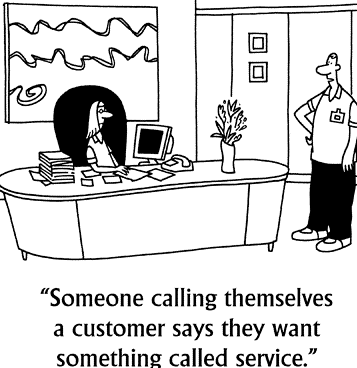
Anything else I can do for you.....?


Incidents happen when you are on desk. Some are funny, some make you think, some are annoying. This was just funny.

An older lady came to the library. She comes often enough that she knows me and comes directly to me for help. She had a paper (torn off a magazine) which had information on how to enter a contest. She could win a purse and she desperately needed one (she said!)

I logged into the site for her but alas! the site required* an email identification from person. Our lady didn’t have one. So she suggested that I provide my email and then call her if she (I) win(s). How is that for customer service? I had to politely reject that suggestion. Any thing else I can do for you……?

Tuesday, September 23, 2008

I am ready to index

Finally! After completing the indexing course through University of Berkeley Extension and setting up my website at Maha's Indexing, I am ready to index and proof-read.

I just need to find some writers and publishing houses to send me their books to index. I have already done a couple - take a look at my samples on the website. If you are reading this and if you have written a book talk to me. I offer great deals for first timers.

http://www.mahasindexing.synthasite.com/

Again, please post your comments. I enjoy them.

Monday, September 15, 2008

Library of Congress and Folger Shakespeare Library in DC


My son and I had a chance to visit LOC in August. Enjoy the show.

Monday, September 08, 2008

My latest publication


Check out my latest publication under publications called Decoarting Cents or click on this icon.

Tuesday, September 02, 2008

Library of Congress

I was on a holiday on the Eastern part of US and had the opportunity to go to Washington D.C. My 8 year old and I visited the Library of Congress and were given a tour of the building. We were both overwhelmed by the sights - how beautiful the building was, the history of it, the history in it. Due to time constraints I couldn't use their reading rooms but managed to get a card to use later - hopefully on my next trip.... I will post some pictures soon.

Tuesday, August 05, 2008

Divi-ing Them Up

Public Library patrons, just like any other patrons, come in all attitudes and moods. I thought I should divide them up. Here are some.

Cyclists: You never know what mood they are in today. They are usually non-expressive, but today they are upset. It could be they had a bad day elsewhere with something else but somehow a library seems like a good place to shake it all away. Have to be very wary of them.

Acrimonious: These patrons are always annoyed. Regardless of how cheerful everything around them is, they tend to show dissatisfaction about everything/everyone. It doesn’t matter how much time you spend with them to find what they need, they are still upset about something: you took too long, your damn computers weren’t fast enough for their research, you don’t have the updated version (which is still not published), the library is closing in 2 minutes and it is so inconvenient (doesn’t matter you have worked the last 7 hours on a Saturday), they don’t want to use databases they just want everything in print, oh! this list can be long.

Cheery: Contrary to the above, there are those who are always cheerful. It doesn’t matter you can’t find anything for them, they are so grateful you just tried. They thank you so profusely and leave.

Naggers: There are those who come in everyday (or call) with a question. One day it is an address, then it is about a product, then it is something else insignificant. Usually they are not looking for an answer. They are evasive about every question they ask and probably just come in to feel important and maybe have some company.

Know-it-alls: Oh these patrons know everything. But they check to see if you do. I added this out of personal experience from my library. They read about something then call the library and check to see if we give them the right answer. God forbid if you give them more than one likely possible answer. They will read the text (proof of their answer) over the phone to you.

Browsers: Then there are browsers – come only to browse the net: Kijiji, Bebo, Wiki – nothing research oriented. They want nothing off you. You might as well be running an Internet cafĂ©.

Porn-ers: Should I mention the porn viewers here…..We usually give them the pink slip and ask them to leave. Many don’t even flinch while receiving the pink slip.

Demanders: These are patrons who never request. There is an “I pay the taxes and You Owe Me” attitude.

I’ll add more as I meet them.

Thursday, June 19, 2008

MySpace and Facebook - Illegal?

ABC has Aftab talking about keepings kids safe online. I am a mother and I am all for keeping mine safe. I am also all for snooping into my kids life. Hey! my mom did so and I turned out fine. I was mad at the time but now I am thankful she was watching me.

It is only harder for parents these days as there are too many social sites. Finding which one your kid is on is your first challenge, then getting into that site and tracing your child and his/her activities is just too much work for any parent today. In some cases, parents themselves are busy socializing on sites and they themselves don't know any better.

But what got me in this article was the reference to MySpace and Facebook being illegal for kids? Is that advertised somewhere or is the author just guessing this? If it is illegal, public libraries are in trouble. To throw in my 2 cents worth social sites should not be illegal to anyone. Humans should only be taught online socializing skills just as we were taught critical thinking and literacy skills and many others I can't bother to remember now.

Wednesday, June 18, 2008

Regulars and Irregulars at the Library

When we open the doors at 10 a.m. they rsuh in to get to the computers. Some yell and fight to get THE computer they want. Once settled they play online games, browse some crappy sites which occasionally includes porn, check their emails, blog, bebo, orkut, chat and after booking a computer for the next day or two, leave. This is the morning routine at our branch. It is the same faces, same issues, and same questions. These are our regulars.

There are other regulars who drop in or call just to chat. They’ll start with a serious question of course – on politics, criminal codes, or any current event that is happening. Then they tell you what they think about those issues, ask you for an opinion. In my case I might have an accent and of course look different so the conversation expands to where I might be from, how long I’ve been here and anything else you can ask an immigrant.

Then there are some who come to flirt with staff. One of our staff members was asked out for coffee by a middle-aged bald guy with an accent. She is a happily married wife and mother of three teenagers and whatever made him think she would be interested in him we would never know. After many appeals to her for a coffee date he suggested that she watch Bridges of Madison County. I guess he doesn’t know that it is also a book. Isn’t there a free club in town where guys like him can hang out?

What about your library? I'm sure you get these fun types visiting you too?

Friday, June 13, 2008

Amazon and Salwar Kameez

This cloud computing service that Amazon is doing is mostly amazing but…. I have seen some clothes being sold on Amazon but was really surprised to see ethnic clothes being sold too. I found Salwar Kameez. They also have African ruppa, kaftan, Dashiki, among other things. I didn’t’ even consider looking for this on Amazon. Actually I was Googling for Salwar Kameez patterns and Amazon showed up.

To me Amazon used to mean the online book store. Not any more. Actually not for a long time. But why? Why does everyone want to be everything? Why is there no focus? Is it really helping the customer or is it just about marketing and profiting. I am slightly put off by this and don’t know why. I have to think harder. Maybe it is because these major cloud services put small businesses out of business, maybe it is the monopolization, maybe it is because I am mentally prepared only to buy books from this store like I am mentally unable to buy bread from Walmart or just maybe I have had bad patrons today.

Libraries are following this same pattern. We want to be Starbucks, information kiosk, computer cafĂ©, and whatever else is out there. I guess we are keeping ourselves in business too. We have been asked why we don’t have fax services, postal services, coffee vending machines, diapers for kids, offer free printing services, and a few other things that I can’t think of now. At least no one has suggested we sell clothes or may be they did and I just don’t know it yet.

Don’t get me wrong. I am all for going with the flow and doing whatever a library should do to keep up with our patrons’ needs. I am a virtual reference librarian and am happy to be one. But I really hope we don’t go tooooooo retail oriented – even in appearance.

By the way Amazon, I buy books from you. I will not buy a cotton salwar kameez for $80 from you.

Wednesday, June 11, 2008

Google Docs

I know! I know! Some of you librarians do not like Google. I disagree. Unlike our patrons, I use it as one of the sources not as my only source.

I started playing with Google Docs – another of Google’s collaboration tools. I hadn’t seriously used it yet when one of my colleagues also brought it to my attention. That made me think about it seriously and wonder if I should design a class to teach our patrons. Think about it! You don’t need to buy Microsoft Office, can access it from anywhere on a computer and share your documents to be seen, worked on and edited at the same time from anywhere in the world. I recently published a paper on Google Co-op with a friend who lives in a different province. Check under My Publications. If you are co-writing a paper with a friend or colleague like I did, and you and your friend happen to live in two different parts of the world this would be a great way to collaborate. You could work on the same paper at the same time.

Panorama Software has partnered with Google to offer new capabilities to Google docs in terms of analytics, reporting and visualization process. You can analyze your data on spreadsheets using panorama’s pivot table. Click here for more on how to use Panorama Pivot Tables for Google Docs.

The three applications currently available on Google Docs are Documents (similar to Word), Presentations (similar to Powerpoint) and Spreadsheet (similar to Excel). You can share any of these withothers (or not) by inviting them as collaborators or just viewers. One important requirement is that you and your collaborator have a gmail id. Talk about marketing!

Your work can be saved and exported in any of these formats: DOC, XLS, CSV, ODS, ODF, PDF, RTF and HTML. From my previous posts you know I am also an indexer. Indexers are quite often asked to export their material in RTF format. If your old MS Office doesn’t have RTF, Google Docs does.

With my little exposure to this I have found that Documents lacks some of the features that MS Word has such as: a smaller tool bar, fewer font options, grammar check (Not that I use it much). I still haven't figured out how to present parts of the slide in a certain order with thier Presentation. The whole slide shows up at once. I want each sentence to appear one at a time as it can with powerpoint. I'll keep working.

Alright, I am beginning to sound like a free advertisement for Google Docs. So I’ll stop now and let you take a look.

Pearl Growing

  • This is another technique that many searchers use sometimes unconsciously.

  • Start with the original idea and go from there.

  • Pearl growing involves false drops and precision.

  • When you send your query to a database you get hundreds and sometimes thousands of results. Not all of them are relevant. The non- relevant ones are called false drops. The relevant ones are precision.

  • You use the relevant articles (your precision results) to find more articles. This could mean you are using citations from the relevant articles (Citation pearl growing) or you are using more words and concepts, subject headings, descriptors from the relevant articles to grow your search further. Either way your pearl is growing.


“Site-ation pearl growing: methods and librarianship history and theory” by Sheryl L. Ramer is an interesting article on pearl growing search for medical information http://www.pubmedcentral.nih.gov/articlerender.fcgi?artid=1175807

Thursday, April 17, 2008

Truncation, Wildcards, Limits and Stop Words

TRUNCATION
This is a way to extend your search for a word. For example: eat* will search for eating, eatery, eater, eats, etc. Not all databases use truncated searches. Some may not accept a truncated search. In most cases a * is used for truncation. Occasionally you might come across a database that uses some other symbol (such as ?) for truncation.

Ex: Using Ind* in Google searches for Indianapolis, International, Industries, India, etc. Of course in Google you have about 103,000,000 for Ind*in 0.22 seconds.

WILDCARDS
Wildcard search is used to find words with various spellings: colo?r will search color and colour, wom?n will search for woman and women. This is very helpful when you are not sure if the article was written in British English or American English.

Note: Wildcard and Truncation symbols may be interchanged by some databases. Find out what symbols are used for what under Help.

LIMITS
Users can also limit their searches by date, language, format, full-text or just abstract, etc. Most databases have a drop down menu of Limit options available.

STOP WORDS
This varies from database to database. Most common stop words are a, an, and, by, for, from, of, to, the, with, etc. Check their Help section to find out which are stop words for the given database.

Tuesday, April 15, 2008

Ph.D in Library Science

For anyone interested in doing their Ph.D in Library Science off-campus, San Jose State University is offereing a Gateway Ph.D Program in partnership with Queen's Univeristy of Technology. It looks like there are some on-site components to this program but most of it can be done as distance education. If you are ready to commit to six years, this is a program for you.

Tuesday, March 11, 2008

Proximity Searching

Some databases allow proximity searching. For example: you can search for the word religion (N) Civil War (N) United States: Here you are looking for all three words to appear NEAR each other in any order.


The user can indicate 5N to indicate that the two words being searched should be within five words of each other in any order.


Another proximity search commonly available is W – for WITHIN. You can search for Library W school.

Proximity searching increases accuracy in searching.

Databases such as Dialog have such refined search functions. When a database consists of millions of entries, this is a better option to search. Databases that have this service will have help information on what proximities searches to use and how.

Wednesday, February 20, 2008

Field Searching

  • This is the ability to limit a search by fields: keyword, author, title, date, subject, etc. This again narrows down results
  • In most databases, field searching is available as a drop-down menu
  • If you do not restrict to field searching, the database searches all fields for the word(s) you put in the search box. This would be keyword search.
  • Other fields that a database may or may not have are (depending on the subject is deals with) : ISBN, ISSN, Journal title, Accession number, Geographic terms or locations, company name, NAICS code, product name, document title, document number, brand name, book review, etc.
  • Some databases have their own subject terms and you will have no option but to choose only from them. One example that comes to mind is the Greenwood Daily Life Online. You can also do a keyword search here but it is more effective to search using their subjects, timelines and geographic locations. Example from Greenwood:

· SUBJECT (view all)
o Holidays and Festivals
§ Carnival
§ Christmas
§ Easter
§ Festivals
§ Holidays
§ New Year's Celebrations
§ Ramadan
§ Spectacles
· TIME
o Ancient (beginning of time to 4th century CE)
o Medieval (5th century - 14th century)
o Modern (15th century - 19th century)
o Present (20th century -21st century)
· REGION
o Africa
o Asia
o Caribbean
o Europe
o Latin America
o Middle East
o North America
o Oceania

If you are not sure where to start, keyword is a good place. But if you know the title, author or the dates between which the item was published you can narrow your search using one or many different fields.

A title search can also be done using websites. For example in Google, to search for a book with a title Gregg Reference Manual, type intitle:Gregg Reference Manual. Searching this way will reduce the number of hits from 173,000 to about 7000. This is a more effective search if you know what you are looking for. It brings up information on the book titled "Gregg Reference Manual", instead of looking for three different words, Gregg, Reference and Manual.

Tuesday, January 22, 2008

Controlled Vocabulary

LC Subject headings, Sears list of subject headings, Canadian Subject Headings, MeSH (Medical subject headings) thesaurus, descriptors, authority control could all be labeled as controlled vocabulary. This eliminates the need for the user to come up with synonyms for search terms

It helps refine ones’ search

Your database may or may not have a controlled vocabulary. But many offer some kind of subject lists to browse or narrow searches. If not, think of other terms you may want to use for an item you are searching: Use 'investment' instead of 'finance', or 'recipe' instead of 'cooking'

It is the lack of controlled vocabulary (selected list of words to search) that casues so much confusion on the web. What you find one day is lost the next.

Stay tuned for more search tools.....

Friday, January 04, 2008

Boolean logic


  • Remember your venn diagrams from yesteryears! That is the basis of Boolean logic.

  • Uses And (+), OR and AND NOT (-)

  • They are spelled in capitals or symbols are used. OR is spelled out

  • AND represents intersection of two sets and will produce smaller results (Note that this AND is not additive. It limits the search)

  • OR represents a combination of two sets and will produce larger results (expands the search)

  • NOT, as the word means, excludes a term you do not want to see in the search. This also produces smaller results

  • What Boolean logic one uses depends on the database and what one is searching for. AND could produce too many results and you might have to use a NOT. Or, NOT might produce too few results and you may have to use AND and OR

Example: Typically, Mandoline NOT Slicer should search for items that are catagorized as Mandolin or Mandoline and omit slicer as a search word. Hence there will be fewer results. (143,000 hits in Google not all of them relevant)
Example: Mandolin OR Slicer will evidently have more results than the previous search. (366,000 hits in Google)
How exactly the results are displayed and what information is retrieved for the user will all depend on the level of sophistication of your database.

(BTW: My new love is for Mandolins that chop or grate your vegetables just perfectly)

More search tools to come.....